

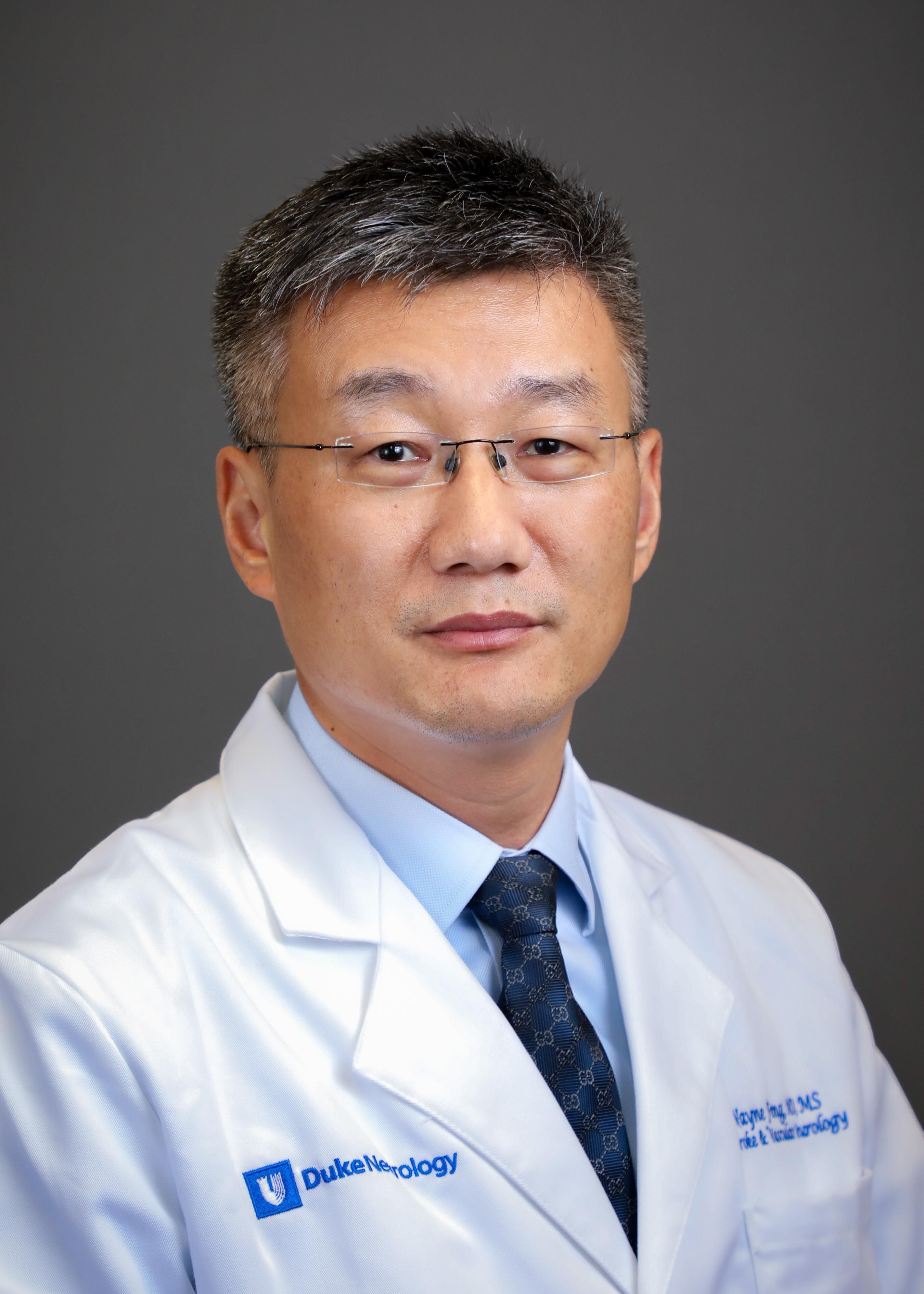
Overview
Wayne Feng is the Chief of Division of Stroke & Vascular Neurology, Medical Director of Duke Comprehensive Stroke Center, and Tenured Profess of Neurology and Biomedical Engineering at Duke University School of Medicine. Dr. Feng is a board-certified vascular neurologist as well as a physician scientist. His research portfolios include developing imaging biomarker for post-stroke motor outcomes prediction, and use of non-invasive brain stimulation tools, such as, transcranial direct current stimulation (tDCS), vagus nerve stimulation, low intensity focused ultrasound and transcranial light stimulation to enhance post-stroke recovery. His research has been actively funded by the National Institute of Health (NIH), the American Heart Association/American Stroke Association (AHA/ASA) and other various sources. He is currently leading an NIH funded 8.9 million U01 12-center, phase II study called TRANSPORT 2 (TRANScranial direct current stimulation for POst-stroke motor Recovery – a phase II sTudy) – on the NINDS funded stroke trial network.
Dr. Feng has published over 150 peer reviewed manuscripts (H index of 36), including two manuscripts featured on the cover page of brain stimulation journal, and one manuscript featured on Journal of Neuroscience. He co-edited - “Cerebral Venous System in Acute and Chronic Brain Injuries” book. He served as the associate editor for Translational Stroke Research from 2019 to 2021(IF=7.0). Dr. Feng received several prestigious awards for his research work in stroke and stroke recovery including the FIRST “Rehabilitation Award” from the American Heart Association/American Stroke Association in 2015, “Franz Gerstenbrand Award” from World Federation of Neurorehabilitation (WFNR) in 2016, Arthur Guyton New Investigator Award, Consortium for Southeastern Hypertension Control (COSEHC) in 2016 and “Clinical Investigator Award” from the Society of Chinese American Physician Entrepreneur (SCAPE). Currently, he is the Section Chair of Neural Repair & Rehabilitation, the American Academy of Neurology. He leads the global mentoring program for the WFNR.